
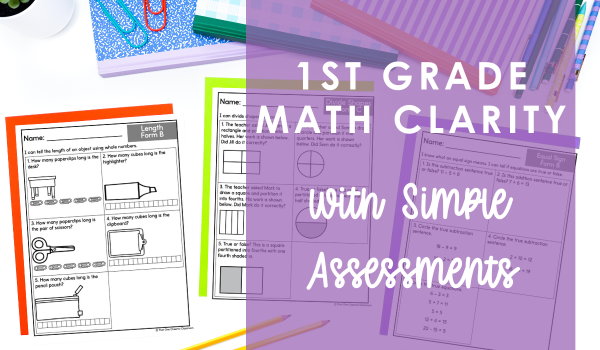
If you’re a first grade teacher, you already know the truth: supporting young mathematicians requires constant observation, quick checks for understanding, and lots of tiny adjustments along the way. A strong 1st grade math assessment system can make that process so much clearer—but finding one that’s simple, kid-friendly, and genuinely helpful isn’t always easy. One minute your students are confidently counting to 120, and the next they’re unsure how to add within 20 or compare numbers that look big but don’t behave the way they expect.
And because first grade math skills build so quickly—almost like stacking dominoes—you need a clear picture of what students understand at each step. The tricky part? Finding the time, energy, and tools to actually gather that information.
Most teachers want to:
- Check in on student understanding more frequently
- Catch misconceptions early
- Support students who need intervention
- Challenge students who are ready to move ahead
- Keep documentation for data meetings and parent conversations
But when you’re juggling behavior, meetings, planning, small groups, and everything else a school day brings… who has time to create meaningful assessments for every single standard?
This is the gap so many teachers feel—and it’s exactly where a simple, organized assessment system can make a world of difference.
Why 1st Grade Math Assessment Can Feel Harder Than It Should
There are a few common challenges teachers face when trying to assess math in early elementary classrooms.
1. Students’ skills develop at wildly different speeds.
Some students come in ready to add fluently, while others are still building number sense. A single worksheet rarely gives you information that applies to your whole class.
2. Traditional tests are too long or too overwhelming.
A six-year-old’s stamina is limited. If an assessment feels like a marathon, you’re not always measuring math skills—you’re measuring attention span.
3. Worksheets often mix multiple skills.
This means you can’t tell which part a student actually struggled with.
4. Teachers don’t have time to create individualized assessments for every standard.
Planning meaningful instruction already takes hours. Adding assessment creation on top of that? Impossible.
5. Schools require more data than ever.
Whether for RTI, progress monitoring, or standards-based grading, teachers need documentation that is specific, consistent, and easy to track.
If any of these feel familiar, you’re not alone. These challenges are exactly why having a simple, standard-aligned assessment system can save you time, stress, and frustration.
What Teachers Actually Need in an Assessment Tool
Most teachers aren’t looking for something fancy. They want something:
- Quick for students
- Easy for teachers
- Specific to one standard
- Aligned to curriculum expectations
- Flexible enough to use anytime
- Consistent from start to finish
And, ideally, something that requires zero prep.
Imagine if assessing your students took five minutes, scored itself in your head, and gave you actionable information immediately. That’s what an ideal system looks like in first grade.
The Solution: Simple, Standard-Aligned 1st Grade Math Assessments
This is exactly why I created my 1st Grade Math Assessments—a complete, print-and-go set of pages that gives teachers targeted data without the overwhelm.
But before we talk about the resource itself, let’s talk about how it solves the exact challenges teachers face.
How This 1st Grade Math Assessment System Solves Real Classroom Problems
**Challenge: Students struggle with stamina.
Solution: Five-question assessments designed for young learners.**
Each page focuses on just one skill and includes five questions, which is the perfect amount to see whether students truly understand the concept—without overloading them. This means:
- Students stay engaged
- You get clean, accurate data
- No one melts down during a “test”
**Challenge: You need to know exactly what skill a student needs help with.
Solution: One standard per page.**
Instead of blending skills together, these assessments isolate each standard so you can pinpoint exactly where misunderstanding begins. That clarity is a game-changer for planning.
**Challenge: You don’t have time to create assessments for every standard.
Solution: Everything is already done and organized for you.**
The entire year is covered—counting, addition and subtraction strategies, comparing numbers, tens and ones, measurement, graphs, shapes, and more. The Table of Contents makes it easy to find what you need instantly.
**Challenge: You need repeated measures for RTI or intervention.
Solution: Three forms for almost every skill.**
Forms A, B, and C let you reassess without repeating questions. Whether you’re progress monitoring weekly or reteaching a small group, you always have fresh problems ready.
**Challenge: You need documentation for meetings and report cards.
Solution: Pages are easy to score and file.**
With five questions per page, scoring is fast and consistent:
- 5/5: Mastered
- 4/5: Nearly mastered
- 3/5 or below: Needs reteaching
This data is perfect for parent conferences, standards-based grading, and intervention meetings.
How to Use These 1st Grade Math Assessments Throughout the Year
You don’t have to wait for a unit test to check in on your students. Here are simple, practical ways to build these assessments into your routine.
1. Pre-Assess Before Teaching a Skill
Pull out the page for the upcoming standard and see what your class already knows. This helps you differentiate before the unit even begins:
- Enrichment for students who already show mastery
- Targeted small groups for students who need foundational support
2. Use as Quick Checks After a Lesson
Want to know whether the lesson “stuck”? Give one of the forms right after instruction. You’ll know exactly who needs more practice tomorrow.
3. Add to Guided Math Centers
Use the assessments as an independent or teacher-led center. Students get practice, and you get data.
4. Use Them for RTI and Small Groups
The clarity of these assessments makes them perfect for intervention:
- Administer Form A
- Teach or reteach the skill
- Use Form B or C to measure growth
5. Keep a Binder for Ongoing Documentation
Organize assessments by standard and add student pages as they complete them. This becomes:
- A progress portfolio
- A reference tool for planning
- Evidence for parent-teacher conferences
6. Use Questions as Exit Tickets
If you don’t want the whole page, choose one question and use it as an exit ticket. Simple and powerful.
Why This System Works for Both Teachers and Students
Students thrive with predictable structure.
The clear layout helps build confidence and independence.
Teachers get back precious instructional minutes.
These 1st grade math assessments take no prep and very little time to score.
The data is clean, meaningful, and actionable.
No more digging through worksheets to “guess” whether a student understands something.
It supports both whole-class and individualized instruction.
You teach smarter, not harder.
The Big Picture: Less Guessing, More Teaching
When you know exactly what your students understand, you can teach with intention. You can respond to misconceptions quickly. You can challenge early finishers meaningfully. You can make your small groups tighter and more effective.
And you can stop relying on long tests or scattered worksheets to try to piece together a picture that should be clear from the beginning.
The right assessment system doesn’t add more work to your day—it removes stress, saves time, and supports better teaching.
Want to Make 1st Grade Math Assessment the Easiest Part of Your Day?
If you’re ready for assessments that are:
- aligned to every 1st grade math standard
- fast to use
- simple to score
- helpful for planning
- perfect for intervention, RTI, or quick checks
- organized so you always know exactly what to pull
Then the 1st Grade Math Assessments were made for you.
They’re designed to support you, simplify your planning, and help your students grow with confidence—all while making 1st grade math assessment something you don’t have to stress over anymore.